
Amboseli · A living register
The named elephants of Amboseli
Since 1972 the Amboseli Elephant Research Project has known this population one elephant at a time. Families are lettered, and every calf takes a name beginning with its family’s letter — which is why Craig was a C, Wikstrom a W, and all of Echo’s descendants are Es. This is our record of the individuals you may cross paths with, and of the giants who came before them.
The bulls still with us
A super tusker carries more than 100 lb (45 kg) of ivory a side. A big tusker carries ivory near but under that mark — many of Amboseli’s younger bulls sit here, and some will cross the line. Roughly ten confirmed super tuskers remain in this ecosystem.
Vronsky
Born December 1976BullSuper tusker
Confirmed a super tusker by Big Life Foundation in 2024. Heavy-built and unmistakable on the plains, though less famous beyond Kenya than Craig or Tim.
Pascal
Born January 1980BullBig tuskerP family
Named by Big Life as one of the bulls following in Craig’s footsteps, actively protected by their rangers. A favourite of guides and photographers working the park.
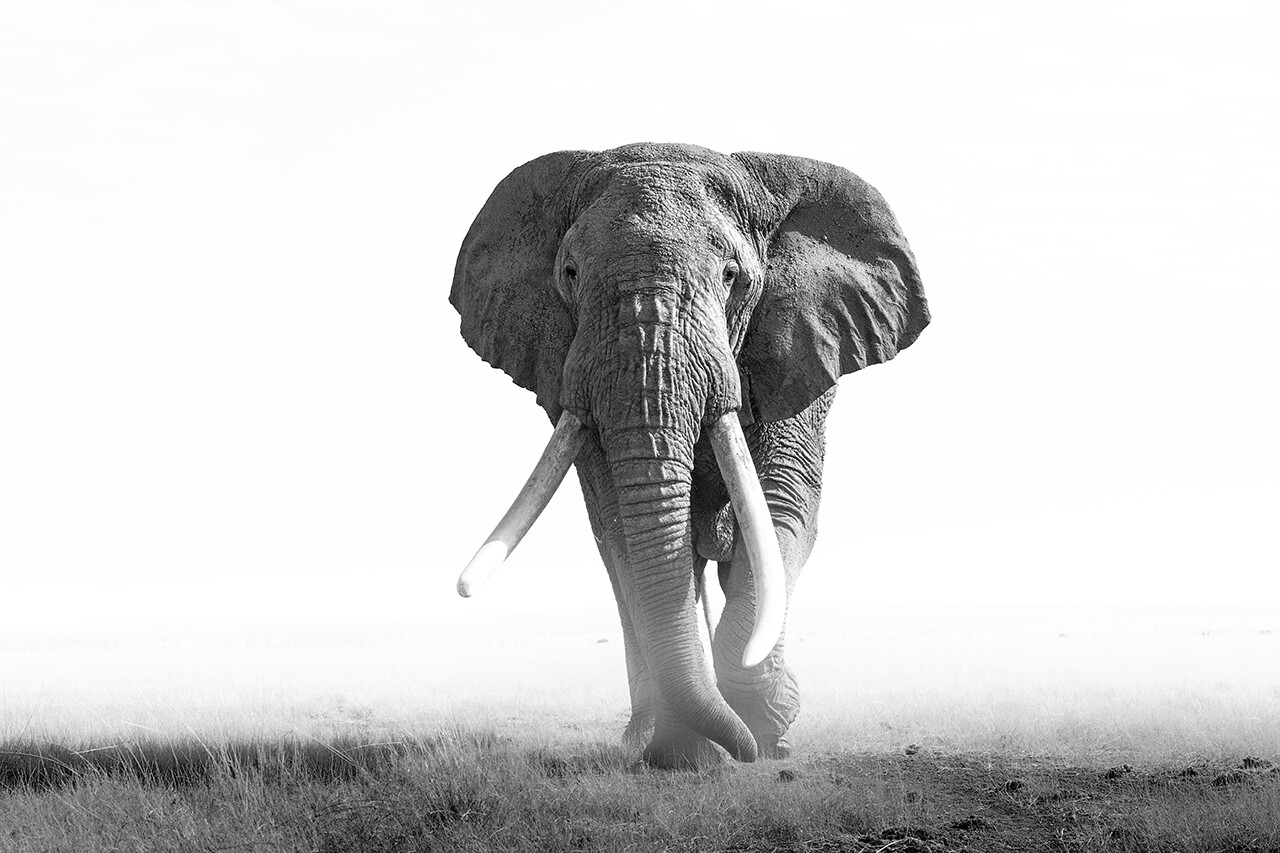
Wikstrom
Born March 1983BullBig tuskerWA family
Son of Willa of the WA family. His ivory is unusually symmetrical, which makes him stand out even among giants. Less celebrated than Craig or Tim, and highly respected by those who meet him in the field.
Tee Jay
Born 1988BullBig tuskerT family
In his prime and still filling out. Ranges widely across the park and the surrounding community land. Hoped by many to grow into Craig’s place among the truly towering bulls.
Esau
Born December 1990BullSuper tuskerEB lineage
A nephew of Echo. His tusks passed the 100 lb mark by the age of 34 — young for it. Fitted with a tracking collar in 2024 by ATE, Big Life and partners, because he regularly crosses into Tanzania where hunting quotas have returned.
Michael
Born May 1991BullBig tuskerM family
An emerging tusker whose ivory is already striking. Widely watched as one of the bulls who may define the next generation.
Per
Birth year not recorded publiclyBullSuper tusker
Broad-headed and heavily built, with tusks over the 100 lb threshold. Regularly photographed in the ecosystem but little known outside it.
X-004
Birth year and lineage unpublishedBullSuper tuskerResearch ID
Known by his research number rather than a name. One of the quieter giants — his genes matter as much as any famous bull’s.
Ganesh
Status unconfirmedBullSingle tusker
Described by visiting photographers as a single-tusked bull and the eldest of a group that included Tim, Craig and Tolstoy.
Only one informal source found. Age, family and whether he is still alive all need confirming with ATE before publishing.
Connor
Status unconfirmedBullC family (by naming convention)
A C name places him in one of the C families — the same letter group as Craig and the CB line — but that is inference from the naming system, not a record.
No published record found. Needs confirming with ATE before publishing.
Palmer
Status unconfirmedBullP family (by naming convention)
A P name would place him alongside Pascal and Paolo in the P families.
No published record found. Needs confirming with ATE before publishing.
Elliot
Status unconfirmedBullE family (by naming convention)
An E name puts him in the EA or EB families — Elfrida’s line or Echo’s.
No published record found. Which E family he belongs to needs confirming with ATE.
The bulls we have lost
Most died of what should kill an elephant: age, and finally teeth. A sixth set of molars wears out in the fifties and the animal can no longer process food. One of these deaths was not natural.
Craig
c.1972 – January 2026 · aged 54BullSuper tuskerCB family
Son of Cassandra, matriarch of the CB family. Amboseli’s largest tusker, each tusk over 45 kg and roughly 2.1 m long, reaching the ground. Calm around vehicles and patient with cameras, which made him the most photographed elephant in Africa. His last molars wore down and he could no longer chew.
Tim
January 1969 – February 2020 · aged 50BullSuper tusker
Tusks of 160 and 134 lb. First noticed by researchers at four years old and followed for the rest of his life. Known for mentoring younger males learning independence, and a favoured mate. Survived spearing and poaching to die of old age; his remains went to the National Museum in Nairobi.
One Ton
First recorded 1996 – July 2026BullAmboseli–Tsavo corridor
Named for ivory that looked impossibly heavy in profile. Ranged the Chyulu region along the Amboseli–Tsavo corridor. The Maasai who shared the landscape with him called him Mpole, the gentle one, for his temperament.
Tolstoy
1971 – April 2022 · aged 51BullSuper tuskerT family
A straight right tusk and a trimmed left one. Died of an abscessed molar — the same slow arithmetic of teeth that takes most old bulls.
Ulysses
1979 – March 2022 · aged 43BullBig tuskerUA family
Speared twice by farmers in retaliation for crop-raiding, in 2016 and 2018, and treated successfully both times before Big Life’s crop-protection fence went up. Died young for an elephant, apparently of natural causes. His tusks weighed 51 and 47 kg.
Paolo
November 1979 – 2025BullSuper tuskerP family
Died of natural causes at a point when very few bulls of his size were left. A reminder that strong protection inside Kenya does not stop the ranks thinning.
Gilgil
December 1987 – September 2023 · aged 35BullGB familyKilled by trophy hunters
Son of Golda, matriarch of the GB family, fathered by the great bull Dionysus. Shot by sport hunters across the border in Tanzania’s Enduimet area, ending thirty years of a cross-border agreement that had protected these elephants. Cynthia Moss and Norah Njiraini identified him from a photograph of the carcass — an elephant’s skin is effectively a whole-body fingerprint. He was only entering his reproductive years.
The matriarchs
No female reaches super-tusker ivory, and a few carry very large tusks regardless. What matters more is what she knows. A matriarch holds the routes, the water and the memory of past droughts, and her family’s survival turns on that knowledge. In 2009 Amboseli lost around 400 elephants, among them 60 adult females — 27 of them matriarchs.
Ulrica
Born 1963MatriarchUA2 family
The oldest female alive in the Amboseli population. Still leading the UA2 family into her sixties, and reported by the field team to be in good condition.
Echo
c.1944 – 3 May 2009 · aged 64MatriarchEB family
The most studied elephant in the world. Named for the sound of the radio collar Cynthia Moss fitted her with in 1973, and recognisable by her crossed tusks. She became matriarch at 23, unusually young, and led the EB family from seven members to thirty-seven. Four BBC films followed her over thirteen years.
Elfrida
Born 1970MatriarchEA family
One of the oldest living females in Amboseli and matriarch of the EA family, which now runs to 73 living members. Two living siblings and seven living calves of her own. Her mother Estella produced the rare surviving twins Equinox and Eclipse.
Angelina
Born 1985FemaleAA family
Daughter of Amy. Gave birth to rare twins in 2020, a male and a female. Both struggled through the drought that followed and the male died in early 2022; researchers chose not to intervene rather than put the family through the stress of separation. The female survived and gained condition quickly. Angelina’s family was the subject of a BBC Dynasties episode.
Kerry
Matriarch, KA familyMatriarchKA family
Brought the KA family through the 2009 drought without losing a single member, at a time when other families lost their oldest and youngest. Both calves born during that drought year survived. The clearest demonstration in the record of what a matriarch’s judgement is worth.
Keira
KA familyFemaleKA family
Mother of Kochab, born 1995. The KA family was among the first photographed by Cynthia Moss in 1973, and among the few to come through 2009 intact.
Cassandra
DeceasedMatriarchCB family
Craig’s mother and matriarch of the CB family, one of the herds Cynthia Moss named in the study’s earliest years. Every C name in Amboseli traces to her line.
Golda
Matriarch, GB familyMatriarchGB family
Mother of Gilgil, the bull shot by trophy hunters in Tanzania in 2023.
Willa
WA familyFemaleWA family
Mother of Wikstrom, born to her in March 1983.
How the names work
Every elephant here carries a name and a code, and both mean something precise. The system was built by Cynthia Moss and Harvey Croze from 1972 onward, as they photographed individuals and worked out who belonged with whom.
Each family gets a two-letter code. The first letter is the letter group; the second distinguishes that family from the others sharing it. Every member of the family is then given a name beginning with the first letter.
So Wikstrom is a W because he was born into the WA family. Craig was a C because Cassandra led the CB family. Read the code and you know the animal’s mother’s family without being told.
There were 58 families a few years ago and there are more than 60 now. The count moves because families split and, occasionally, because they end. There are no N families left in Amboseli. Both of them died out when the last of their females did.
W A
- WThe letter group. Every member’s name begins with this letter — Willa, Wikstrom.
- AWhich W family. WA and WB are separate families in the same group.
-
No name is ever used twice
In more than fifty years and over 1,400 named elephants, no name has been repeated. Most ordinary names went long ago, so the researchers now reach for nicknames and unusual spellings.
-
A calf is not named until it is four
Until then it carries a code built from its mother’s name and its year of birth. Four is the age at which a calf has come through the period of highest mortality, so a name is largely something an elephant earns by surviving. The exception is ATE’s sponsored naming programme, which will name a younger calf on the clear understanding that not every one of them reaches adulthood. Angelina’s male twin was named Amora and died before his second birthday.
-
The founding generation was named for how they looked
The first elephants identified in 1972 were described before they were catalogued: Wart Ear, Curtain Ear, Big Tuskless, Three Holes, Slit Ear. Others were named for the circumstances of first contact — Echo and Sona both take their names from the sound of the radio collars fitted to them.
-
Bulls keep the letter but leave the family
Daughters stay with their mothers for life. Sons disperse in their teens to live alone or among other bulls, but keep their natal name. That is why the great tuskers turn up as single letters with no herd attached — Ulysses of the UA family, Gilgil of the GB.
-
A family is not only a bloodline
Around 1977 a female the researchers called Three Holes appeared in Amboseli having lost her own family. She joined Isabel’s IA family and in time became their matriarch. Elsewhere a D female left with an unrelated female and the two of them founded a new family unit outright.
Family trees
Families are lettered, and a calf takes a name starting with its family’s letter. Daughters stay for life; sons leave in their teens to live alone or among other bulls, which is why the great tuskers appear as branches that lead away from the tree. These are partial — only the individuals whose parentage is on public record.
EB family
Echo’s line. Associated with the EA family.
- Echo c.1944–2009 · matriarch from age 23
- Ely b.1990 · son
- Ebony son
- Esprit last calf
- Enid daughter · leads a subgroup
- Edwina b.1982 · granddaughter · leads a subgroup
- Ella Echo’s sister · subgroup ranges to Selengei
- Elettra Echo’s niece
- Evaline first calf
- Esau b.1990 · Echo’s nephew · super tusker, now solitary
EA family
73 living members — one of Amboseli’s largest.
- Estella mother of the line
- Elfrida b.1970 · now matriarch · 7 living calves
- Equinox b.1980 · twin · still in the population
- Eclipse b.1980 · twin · died in the 2017 drought
AA family
Subject of the BBC Dynasties elephant episode.
- Amy mother
- Angelina b.1985
- Twin daughter b.2020 · survived
- Amora b.2020 – 2022 · twin son · lost in drought
- Amber sister · calved 2010, helped by Angelina
- Angelina b.1985
CB family
First studied in the project’s earliest years.
- Cassandra matriarch
- Craig c.1972–2026 · super tusker
GB family
One of the few records naming both parents of a bull.
- Golda matriarch
- Gilgil 1987–2023 · killed by trophy hunters
- father: Dionysus
- Gilgil 1987–2023 · killed by trophy hunters
WA family
- Willa
- Wikstrom b. March 1983 · big tusker
KA family
First photographed in 1973. Came through 2009 without a loss.
- Kerry matriarch through the 2009 drought
- Keira
- Kochab b.1995
UA2 family
- Ulrica b.1963 · oldest living female in Amboseli
About this record
We add to this page as we photograph these elephants ourselves and as we licence images from the people and organisations who have documented them for decades. A profile without a portrait is not a gap; it is an elephant we have met on the page but not yet in the right light.
Sightings are never promised. The bulls range far beyond the park, some of them across an international border, and a good guide will tell you the same. That is rather the point.